Thursday, August 22, 2013

One Man's Trash is Another Man's Obsession


If you are looking for a good fire house story you may be disappointed today.  This one is just a peek into my other-than-the-firehouse world.  As a kid, collecting fascinated me.  I started a candy wrapper collection, a patch collection, a sticker collection, a bottle cap collection, and a matchbook collection, just to name a few.  In my preteen years beer can collections were big.  It seemed like everyone had a beer can collection, and I admit, I thought they were really cool.  Who could forget the Old Frothingslosh ladies, or the coveted Sunshine Beer can?  The problem was that I got a late start.  My friends had established collections, I couldn’t BUY beer, and my dad was not much of a drinker.  How would I be able to catch up?  Then one day, it hit me…  I decided to collect soda cans.  A friend of mine, Brian Schubel, was the only other person in the WORLD that collected soda cans.  I have since found out that there are hundreds of kooks just like me and  Brian 

I used to collect soda bottles by knocking on neighbors doors.  Back then, you could get anywhere from $.02 to a nickel for a returnable glass bottle that would be returned to the bottler, washed and reused (Now, kiddies, THAT was recycling!) I would haul my loot, as well as my grass cutting money to Mays’ Sandwich Shop in West Lawn and start buying cans of soda.  My delivery system was mighty efficient, with my wagon hitched to the back of my bike.  Supermarkets were a virtual smorgasbord of colorful cans and flavors as well.  You didn’t have to buy whole cases then either, and two or three dollars could score you one of every Shasta flavor on the shelves.   How I managed to survive that first summer without getting diabetes, I will never know.  
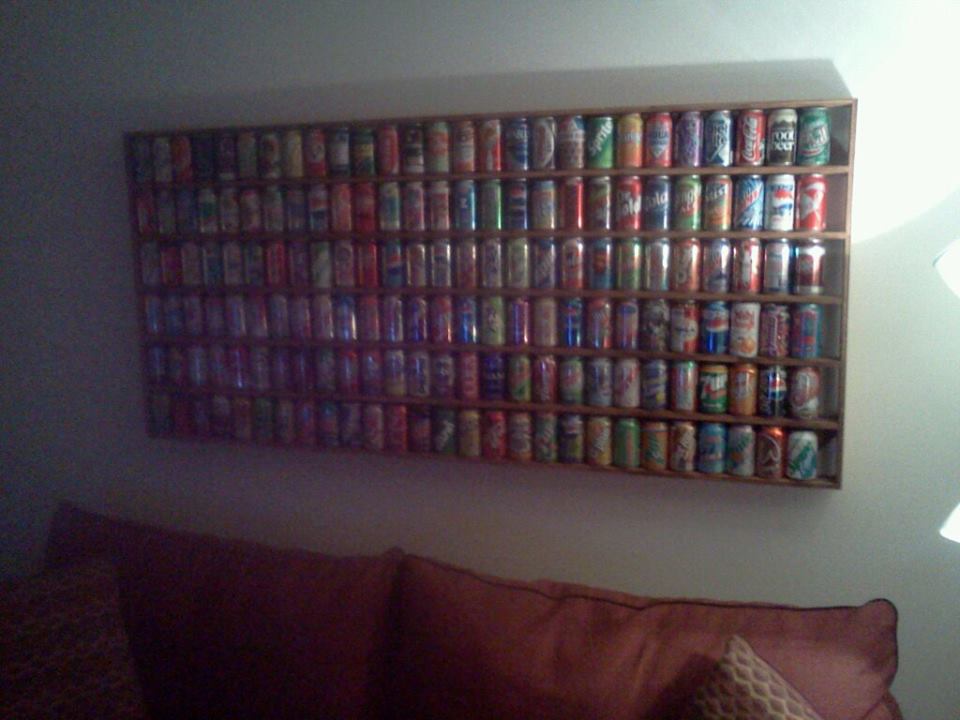
 
I began to stack my umpty cans in a pyramid in my parents’ basement, and then took up shelf space where the games and puzzles used to be stored.  One of my junior high wood shop projects was a pair of shelves designed specifically to hold 324 cans (counting the collection occurred weekly!)  I can still remember carrying those buggers home, and to this day, I still have them in use!  Thank you, Mr. Witman, for teaching me the finer skills of woodworking.   

The passion became an obsession when my family went down the shore for vacation.  Armed with a few empty trash bags, I declared to my mom that I was going to “check the nearby trashcans” for soda cans I needed for my collection.  I think she was ready to alert the lifeguards, because I became so wrapped up in my hunt that I lost track of time. The beach is really long, and the rows of trash recepticles kept calling my name. Several hours after my departure, I slunk back to the family blanket area dragging three FULL garbage cans full of cans.   

There was a bit of a fight whether this “garbage” was going in the car or not.  I had to dig through food wrappers, dirty diapers, yellow-jackets, and half-eaten hotdogs to snag some of these beauties; I was not leaving the beach without them!  As promised during my begging compromise, I sat outside at our vacation trailer with a garden hose and a sponge rinsing away the lipstick, sand, suntan oil, sticky residue, wadded up napkins and cigarette butts that infested my loot.  Once I washed and dried them all, even my embarrassed family had to admit, some of these cans were really awesome.  I found brands that I never heard of before, and a whole load of 10 ounce cans from Canada, written in French as well as English!  I had an international soda can collection going! I can still recall how they sounded as they rattled in the back of the family station wagon on the way home

I have been collecting non-alcoholic beverage cans for over 37 years now and have upwards of 5000 different cans and counting.  I store them in crates that state "USE BY OTHER THAN REGISTERED OWNER PUNISHABLE BY LAW". I know, I am such a rebel, right?  Road trips always include random stops at mini-markets and grocery stores.  I have learned to ignore the strange looks from cashiers over the years.  I have had friends who travel send me cans from foreign countries, and I have made more than a few stops at post offices to ship myself cans.  It saves the scrutiny I get from the TSA agents at the airport screening stations.  

I can’t imagine NOT collecting cans.  It has become part of me.  One day I will pass my collection on to my daughters.  I don’t think they share my passion, but they do keep an eye on the metal recycling rates. 


Tuesday, August 20, 2013

All this food and nothing to eat


Anyone who knows me understands that I am a meat and potatoes kind of guy.  I like things simple, especially my food.  Every now and then, however, I enjoy a trip to the Chinese buffet for a change of pace.  I still stay away from the dishes that have a mixture of more than three items.  I don’t like my foods to TOUCH, let alone combine.  I usually go for some plain rice and one of the many varieties of chicken they offer.  Hmm, that reminds me of a good joke, but telling it now may get “meowt” of my train of thought.

While I sat quietly, taking in the sights of the place, as well as way too many calories, I was thinking about my blog.  I think the last time I posted was probably around the time I was last at the Chinese buffet.  I was thinking about my blog because I was recently given a deadline to post a new entry by a new friend and writing coach.  I had not written in a while.  It wasn’t for the lack of topics; my mind is constantly pondering life, and metaphorically analyzing the things I observe in life.  Lately, I have felt filtered, and have been hesitant to post my thoughts.  Perhaps it is because recently, there have been a few wonderful opportunities to scald some of my past nemeses, and I am trying to take the high road. I have been hearing the approaching whistle of the karma train; could I be waiting to see who gets waffled this time before I sing about it?  Maybe I only get inspired when I eat Chinese food?

Whatever the reason, here I sit, tapping away on the keyboard, with no particular place to go.  I wanted to do a piece about “accountability” and its many meanings.  Having missed my recent deadline, I don’t think this is the best time to post that.  Hypocrisy lost out to honesty this time around.  I also have been working up a catchy metaphor between fire stations and Chinese restaurants.  Some of my thought include: “Does anyone really come here for THAT?”, “Chopsticks and other silly tools of the trade”, “You don’t belong here, let the Italians make the pizza”, and “Pffft, a salad bar?”  Of course, there are the stories that often light people up; the funny ones as well as the ones that make you shake your head in disbelief.  

I sat in that restaurant for quite some time, pondering life, wondering what’s next for me as well as all the others dining with me.  I kept waiting for my brain to click as I sat, trying desperately to come up with the perfect topic for my next blog post.  I suppose you figured out by now that it never happened.  I had a mind full of thoughts, but nothing lit me on fire.  

Anyone in the fire service understands a dry spell like this; and we all know what happens next.  So, brace yourselves and keep your boots by the bedside.


Wednesday, May 8, 2013

The Class A Retaliation


During a recent series of fire extinguisher training classes I was conducting, I recalled an incident from about 10 years ago that I shared with my class.  This story perfectly  demonstrated the simplicity of operating a fire extinguisher. 

There was this real bratty kid named Rebecca that lived down the street.  She was a feisty little know it all 12-year old, with, as you may imagine, very few friends.  It was hard to imagine considering her diminutive size, but this tiny little punk had a real mean, bully streak in her. 

My daughters Ashley and Stephanie were 7 and 11 at the time, and enjoying the early days of their summer break.  One of their favorite activities was sidewalk chalk artwork.  On this particular sunny afternoon, the two of them were in front of the house toiling away at their most recent Technicolor masterpieces of hearts, rainbows and stars when Rebecca the Wrecker paid them a visit. 

It seems that her parents, clearly oblivious to their offspring’s complete lack of respect of others, purchased her the latest version of the “Super-soaker” water pistol and sent her out to play.  If real life were like TV, my daughters would have heard the doomsday music that usually accompanies the villain’s prowling.  Sadly, real life has no soundtrack.  Most of the other kids on the block spotted her in time and decided a bike ride around the block was their best defense.  My girls were caught off-guard; unarmed and defenseless against the Rebecca’s ambush.  The assault was over fairly quickly, and the sneak attack provoked some shrieking and dodging skills (that they sure didn’t get from me), but still left them both peppered with streaks of water before Rebecca’s “clip” ran dry and she needed to retreat to reload at her dad’s garden spigot.  

The Hostetter girls had lost the battle, and their water wounds were extensive.  Even the precious sidewalk art received some damage in the unprovoked attack.  I had caught a glimpse of the battle and anticipated that my girls would be inside in the next few minutes.  I was wrong.  I peered outside about 5 minutes later and there they were, happily drawing on the sidewalk again.
 
That’s when I noticed the two pressurized water extinguishers strategically positioned in the driveway by the side of my truck.  My excitement mounted when I realized what they had up their sleeve.  Part of me was upset that they retrieved the fire extinguishers from my garage where I stored all my training aides without seeking permission, but part of me was thrilled at their spirit and pride.  I relocated to the second floor window with a glass of iced tea and waited to see history unfold before me.  Before long, here came the brat, boldly strolling up the sidewalk with her weapon reloaded and ready for the second wave of assault.  I knew they had a plan.  I could see them watching Rebecca out of the corner of their eye and whispering to each other quietly.  They acted as if they didn’t see the intruder and calmly wandered over to the driveway and assumed their positions, one at the front tire, one at the back tire.  I shook with anticipation as I watched them each break the seal and pull the pin on their extinguishers.  Seconds seemed like hours.  They waited patiently while Rebecca cautiously crept closer. 
 
Finally, they unleashed a wave of retaliation never before witnessed on Whitfield Blvd.  With pinpoint accuracy and synchronized precision they unloaded those cans on their intruder; one around the front of my truck, one around the back of my truck.  Poor little Rebecca never knew what hit her.  Her feeble attempt to fight back with her dribbling stream was no match for the tandem attack from my little firefighters and their 30 foot aquatic range.  She dropped her squirt gun and started running home.  Without hesitation, my girls took off after her, draining every last wheeze of liquid on the back of her obnoxious curly head of hair as she screamed and cried her way home.  Even Mrs. Murray from across the street was laughing at the spectacle, as she saw the entire event unfold from her Adirondack rocker on her front porch. 

Now I wasn’t sure what to do.  I thought about taking them for ice cream to celebrate their bravery and acknowledge them for standing up for themselves, but the story didn’t end there…

Although I expected them to come running into the house pumped with adrenaline, the house remained eerily quiet (never a good sign when you have kids).  Peering out the window, I saw lots of buzzing activity from my two little warriors.  In the garage, into the shed, back to the garage…then silence…  I had to investigate!  Cracking open the door to the garage, I could hear what sounded like Santa’s elves; busy, focused, tapping, clanking of tools, whispered directions…what were they up to? 

Suddenly, the back door opened up and in bounced Stephanie.  She wanted to know if they could get the hose bib turned on so they could use the hose.  A leaky valve prompted me to shut off the feed to the garage faucet a few months ago.  I made a mental note to myself to fix the valve and asked, “Why do you need the hose?”  I must admit, I felt a little guilty deceiving my little girl like that; but I knew they were planning for the next wave of Rebecca Brattypants, and I did not want them to know I saw them with my extinguishers.   “We want to wash up the mess from our chalk!” her little angelic face never cracking from the outright fiberoni she was feeding me.  I played along and turned on the water feed to the garage. 

It was probably 30 minutes later, when the two of them strolled in, as innocent looking as new born babies.  Not a word was spoken of the confrontation that had taken place out front.  Perhaps they were afraid I would be mad that they “fought back”.  Maybe they were afraid they would be angry that they tampered with my extinguishers.  I let them stew over what they had done, and waited for the confession to gurgle out, but it never did.  I soon found out why. 

I went into the garage to check on the extinguishers they had used, knowing that I would find that they had been tampering with them.  That’s when I was stunned with what I saw.  Both extinguishers had been refilled and were back in place on the shelf in the garage.  It took some careful investigation work to realize that they used a milk jug from the recycling can to carefully measure 2 ½ gallons of water to fill them, and the bike pump under the work bench had fresh wet handprints in the dust that covered everything else on the shelf.  They weighed exactly what a full PW should weigh and the pressure gauges were dead on.  The pins were back in place, and they even attempted to reattach the tamper seals! The electrical tape was the giveaway.  

Needless to say, I was a proud poppa.  Not only could they operate a fire extinguisher with the swift accuracy of a seasoned firefighter, they knew (or somehow figured out) how to restore them to service condition.  I had a tear of pride in my eye as I dug out two new seals and completed their field service work.  I never spoke of the incident with them, and they never fessed up to me.  I looked up the statute of limitations on a crime like this, and it is 10 years.  I figure they have about 5 more weeks to keep their secret before there is nothing I can do about it.  I suppose I will finally find out if they ever read my blog.  

Wednesday, November 21, 2012

Those Three Little Words

During my first few months at the College Park fire station in the autumn of 1985, I learned several unique lessons.  Oddly, the most important rule I learned was not one I expected, but have come to truly understand.  It was all about the THREE LITTLE WORDS they never wanted to hear come from your pie hole. 
At first, the use of these three words seemed harmless, and not being allowed to say them felt like a silly, but manageable phase of initiation.  What harm could come from saying them.  They weren’t argumentative, offensive, racist, or harmful words.  They were simple words that would be used to start a sentence, to define a source, to establish validity of a story.  These were words often spoken with pride, yet here, they were poison. 
It soon became apparent that resisting was going to be difficult.  I found myself wanting to use these words … a lot.  As I became more comfortable in my new surroundings, I began to become frustrated by this seemingly ridiculous rule.  I tried and tried, but often had to catch myself as these words escaped my lips.  My frustration led to anger.  How dare these people restrict my language by eliminating these three little words?  I could understand eliminating phrases like, “I don’t think…”, or “I don’t wanna…”, or “Why must I…”, or “I just can’t…”   These negative statements should ALWAYS be avoided by anyone striving to achieve greatness.   In an organization that relies on teamwork, they could be considered rebellious.  Even Jeff Spicoli’s famous line, “I don’t know”, wasn’t restricted.  Thank Goodness Mr. Hand wasn’t a line officer, huh? 


The three words that seemed to get everyone’s panties in a bunch were “Back Home We”.  Nobody cared what you did “back home” at your fire station.  You were here in Prince George’s County, serving as a member of the College Park Volunteer Fire Department.  The only thing that mattered is that you knew how things were done HERE! 
It didn’t take me long to learn why “back home we” was so toxic.  The College Park Station was staffed by students in fire protection curriculums.  We had ALL come from rather progressive departments, and each of us represented the best of the youth from our respective departments.  That’s 12 smart individuals from 12 different departments, most of which did things a little different from the others.  This wasn’t the West Lawn Fire Company, and despite my beliefs at the time, there was always another way to do things.  If the CPVFD allowed the “back home” influence from every one of the probies that walked through their doors, their identity, traditions, reputation and sense of solidarity would be eroded. 
In time, as I progressed through the ranks and I had proven myself to the officers and members of the department, my opinion began to matter.  Once I had firmly implanted myself into the ways of the CPVFD, the knowledge I brought from the WLFC became relevant.  I am proud to say that some ideas that were born in little ‘ol West Lawn Borough were incorporated into programs in the City of College Park.  Eventually I was permitted to say “Back home, we…”, but not before I learned why I couldn’t as the new guy in the house. 
I learned to understand patience, and tolerance for others opinions.  I realized that I was the new guy in town, not the organization.  They had been hosin’ and truckin’ for decades before the mere consideration of my existence.  Despite how smart I thought I was, I thankfully learned that others may be smarter.  The humbling experience of being forced to forget the past and accept the present was a valuable lesson that now, makes all the sense in the world. 
This is a lesson that I have applied numerous times in my life.  As the new guy, I always take the time to get to know the people and the system that is in place, giving them every opportunity to show me what is already in place.  This open-mindedness has helped me learn quite a bit about organizational philosophies as well as individual capabilities.  I only wish others in my recent past would have learned the same lesson of respect that the CPVFD taught me.  THAT story, I will save for another time...
Happy Thanksgiving, everybody.  Enjoy a safe and wonderful time with your family and friends as we celebrate of the "things" we have in life .

Friday, October 12, 2012

A Memorable Beginning

It doesn’t seem like it was that long ago, but it has been over 27 years since I started my second tour of duty as a fire department “probie”.  I was 21 years old, and was certain that I had all the answers.  Up to this point, I had been hanging around my hometown fire company for as long as I could remember, and knew every inch of the apparatus, had polished, painted, or sharpened every tool, knew every knot in the book, and was a sponge for training classes.  I had officially joined the fire service on my 16th birthday, but already knew the names and locations of all the equipment as well as the current members.  After graduating with honors with my Associates Degree in Fire Technology from my regional community college, I was ready for the big time; I was accepted into the University of Maryland at College Park. 
As the opening semester approached, I was still uncertain where I would be living.  I didn’t want the normal housing arrangements of a transfer student; I wanted to live in a fire station.  As my parents would likely attest, I was pretty much living at my local firehouse already, so It shouldn’t be much of an adjustment.  Other than being responsible for my own laundry and running considerably more calls, how much different could it be?   
 The University placed me at the Hyattsville Station, a few miles south of the campus.  I visited the station, met Chief Moltrup, and a few of the members gave me the tour of the place.  As excited as I was to be in a “big city” station, I was a bit disappointed.  I knew several past alumni of the College Park Station, and my heart was set on living there.  I wanted to be part of the stories that are told by the great achievers in the fire service who rode proudly out of the 12 house.  Most importantly, I wanted to be on campus, and surrounded by students that shared my goals of fire service greatness. 
There was something special about the fire station at 7507 Baltimore Boulevard.  The building wasn’t going to win any beauty contests.  It had been “rode hard and put away wet”.  It lacked many modern amenities, but it had an alluring charm.  From the rub marks on the bay door trim from the apparatus squeaking through, to the personalized cubicles in the student “sackroom”, this old place was calling my name, and I was ready to jump aboard.  Sadly, all the spots for the upcoming semester were spoken for.  It didn’t stop me from visiting, several times that summer, each time telling my saga to another few members I had the opportunity to meet.  I memorized the phone numbers as well; and I am sure the chief was tired of hearing me beg for a spot.  Finally, another visit to the station put me in the company of Fred “Hacksaw” Welsh, the chief in charge of filling the Sackroom.  He informed me that one of the candidates that were to report for the fall semester had not been returning his calls to verify acceptance of his spot.  I am not sure whether he was tired of me pestering him, or if I managed some award-winning puppy-dog eyes and sad-sack pout, but Hacksaw (you know, I never found out exactly why he got that nickname) gave me the best news I had heard in months.  “I’ll tell you what, If I don’t hear from this guy by 6:00 p.m. tomorrow, the spot is yours.” 
The next 22 and-a-half hours seemed to crawl by, but as promised, I received the phone call at exactly 6:06 the next evening.  I was IN, and with only 22 days to go before the start of the semester.   It was the beginning of an amazing period of growth and discovery.  The 28 months I spent serving the College Park Volunteer Fire Department met or exceeded every expectation I had, and I have a truckload of friends, stories, memories, and life experiences that have become part of me. 
I am not sure what the best part of the experience was, there were so many.   Was it the college education I earned, the campus life experience, the diversity of people I interacted with, the tradition I was a part of, the friends I met, the life lessons I learned?  Perhaps it was all of it!  For such a brief period of my life, that window of time certainly stands out, and still does to this day.  I am sure I didn’t know it at the time, but it is all very clear to me know.                 
It makes me wonder who is in my life that is going through one of those life defining periods of their lives right now.  If I am a part of their memory 27 years from now, I sure hope the memory is a good one. 

Wednesday, October 10, 2012

Staff Infection

For decades, the volunteer fire service has been struggling with staffing issues.  Decreasing numbers of volunteers have been the topic of fire service discussions across the country.  The reasons are plentiful: the economy, the changing domestic profile, other worthy causes biding for our time, the increasing risks, the elevated training requirements, etc…  
While these reasons have some degree of validity, there are plenty of solutions to help relieve them as valid excuses.  We are just too lazy to give the effort it would take to solve those problems.  The sad truth is that we have a manpower problem because we don’t know how to manage people!    Situations can be managed, things can be managed, time can be managed, money can be managed, and even groups of people can be managed.  But I am not talking about TEAM management here; I am referring to the management of a single person.  Also known as, “how to treat people”
Sadly, many of today’s fire service leaders do not have the skills to properly manage themselves, let alone another individual.  Most develop an image of exactly how their “soldiers” should be; make a plan that utilizes those soldiers, then cast off anyone that doesn’t fit their mold.  A baker who uses a cookie cutter will always gather the leftover dough, re-roll it, and make a few more cookies.  Sometimes the leftovers can be molded into some other culinary treat, but nothing ever goes to waste.  Not in the fire service, however.  One by one, we cast off perfectly good “dough”, and discard it without any thought of what that one extra “cookie” could mean to the organization one day.  Those with pet dogs know that once the scrap hits the floor, you simply aren’t getting it back. 
Today’s leaders lack the ability to nurture, develop, and utilize the variety of people that come in the door, willing to help.  They wastefully discard people like they are an endless commodity because it is much easier than “dealing with” the challenges that some people present.  Worse yet, these leaders are breeding an entire generation of like-minded thinkers.  These little bullies are pushing away great people… smart people… dedicated people… people whose only weakness is the unwillingness to tolerate the bullshit that gets flung around a fire station.  I’m not just talking about the narrow-minded veterans who only know one way to get things done.  I am also talking about the 2/20 guy whose duffle bag is still swinging on the hook. 
I would love to staff a fire department with all the individuals who left the fire service because of the way they were treated.  I think of all the years of training and experience that are being wasted because we simply don’t know how to treat people right.  I have had several long conversations with former members of the fire service, and the underlying theme is interesting.  They feel abandoned, under-appreciated, and unwelcome.  These men and women still have the desire to serve, the willingness to sacrifice, and the ability to be great assets to the organizations that left them behind.  Sadly, the leaders of those organizations have done little or nothing to reel them back in; they never investigated the problem, therefore they didn’t need to execute a solution.  They just kept spinning the revolving door, wondering why their staffing levels aren’t a robust as they want them to be. 
THESE past members are the people who should write the books on recruitment and retention.  Their wisdom and experience could go a long way toward solving the staffing crisis.  Here are a few of the topics they would likely suggest:
·         Be fair to everyone.  If you make a rule, make it for everybody.
·         Don’t make rules that hamper your effectiveness.
·         Communicate, communicate, and communicate.  Secrets demoralize troops!
·         Understand that individuals have lives outside the firehouse; support that notion.
·         Not everyone has to be the nozzleman, if you have a happy hydrant man, be happy to have him.
·         Politicians should not dictate fire service operations, despite how powerful they think they are.
·         What motivates some doesn’t work on all.  Be flexible, be creative.
·         A dangling carrot nets better results than a prodding pitchfork.
·         People like to be lead, so if you are a leader of the organization, LEAD already!
·         Take notice of the positives, and stop dwelling on the negatives.
·         Give everyone the opportunity to achieve the greatness they seek.
·         Everyone is an expert at something.  If you don’t think so, you are missing out!
·         Honor, respect, appreciate, and encourage.
Take notice that most of these suggestions are about how to treat people, not how many certificates you have.  Firefighters are people first, and if we keep forgetting that, all the wisdom in the world won’t help solve our staffing issues. 

Tuesday, September 25, 2012

Concrete Training

Nothing beats real world, on-the-job training; particularly in the fire service. 
It has always been a major challenge of the fire suppression providers to simulate real world scenarios.  How do you create a potentially deadly, deteriorating atmosphere in an unknown location with the urgency of saving a life (while preserving your own) without destroying property and killing recruits? 
There are hundreds of ways to development skills needed to function in an actual burning building.  We negotiate mazes with blanked out SCBA masks (like blind mice looking for cheese), repetitively practice with our equipment to hone technical skills into thoughtless reflexes (while sitting on a chair in the engine room), we flow nozzles (onto sunny parking lots) to give pump operators and nozzle jockeys time to develop natural reactions and thought processes.  We watch videos, we tell stories, and we read articles and books.  We pre-plan, chalk talk, and “what if” ourselves to death.  We participate in scheduled drills, we attend structured classes, and we obtain “certifications” by jumping through some carefully monitored and well documented “hoops”.  While these tasks may prepare us for the real deal, they certainly don’t recreate it. 
Many will argue that live burn sessions are the only way to properly prepare a firefighter for the real action he or she may face, and in many way, this type of training is very helpful to measure one’s abilities in certain areas.  Certainly, a live burn will assure that a candidate understands the purpose of the PPE, and the importance of maintaining it and wearing it properly.  It is an important tool for measuring one’s ability to remain calm, tolerate heat, and negotiate with limited visibility.  There is also no better way to drive home the lessons about staying low, NOT opening a fog pattern into a superheated space that you occupy, the importance of good timing with your ventilation techniques, or why proper radio use is so very important. 
Then there are the drawbacks to this type of training… The things it can’t teach...  Worse yet, are the habits we can develop when we train in a concrete prop more than we fight real fire.  Such as:
·         Real fire doesn’t check your schedule…or the weather
·         Real fires require overhaul… LOTS of overhaul
·         Real fires threaten property that can be SALVAGED
·         Real fires aren’t over in 4 minutes
·         Real fires decompose buildings in short periods of time
·         Real fires should be completely extinguished the first time
·         Real fires don’t wait until your crew, back-up crew, vent team, RIT team and water supply are all set and ready to go
·         Real fires don’t let you try it again
·         Real fires don’t show you the floor plan and escape doors
·         Real fires ignore the safety rules
A live burn session is a great tool to use to help teach a firefighter, but FAR from a simulation, and certainly not the ONLY tool that should be used to measure a firefighter’s ability…that’s what certifications are for, right?  More on that powder keg topic next time…
Stay safe Brothers and Sisters!

Tuesday, August 21, 2012

I Am Not Sure Where This Is Headed...

Deeply rooted in the volunteer fire service, I evolved from a system with ample manpower.  If you were slow getting to the fire station, you didn’t have a place to ride.  We filled cabs, tailboards, and even rode the hose bed to fire calls.  I know what you are thinking; I cringed when I typed that as well.  What can I say; we have come a long way in regards to firefighter safety in 32 years!
I could write volumes about how technology has changed the fire service, and I imagine in time, I will.  But lately, I have been thinking about the issues of manpower.  The most irreplaceable commodity of the fire service is staffing, and the willingness and ability of qualified personnel to overcome fear and risk self-preservation in order to accomplish extraordinarily heroic acts to save life, property and community. 
How that staffing is amassed differs from community to community, sparking ongoing debates about certification requirements, qualification standards, and career vs. volunteer debates.  Originally staffed by the entire able-bodied population, armies of volunteers managed to get wet stuff on the wet stuff, and preserve their communities.  Over time, the evolution of the fire service staff has taken many different twists and turns.  Firefighting has become more technical, standards of training have been developed to offset liability concerns, and the demographic of the American family has drastically changed.  While some communities manage to maintain their fire protection with an all-volunteer staff, many municipalities have adopted a combination-department, where volunteers are supplemented with career staff.  Still others have turned into an era where the staffing is primarily career, and supplemented by volunteers.  Finally, there are areas (mostly metropolitan regions) that are staffed by career firefighters, and volunteers do not exist. 
The city of Reading, Pennsylvania, for example, is home to one of the oldest functioning volunteer fire companies in the country; although their presence on the fire ground is barely noticed.  This city of 88,000, people, situated on 6400 acres, is protected by an on-duty staff of just 18 firefighters; a dangerous situation for the overworked staff, their force limited by budget restrictions by the cash-strapped city.   Injury rates have increased by 80%, likely caused by the stress of working overtime to fill staffing minimums, and being forced to accomplish the work of several personnel because of the staffing shortage.  Volunteer support within the department, while technically present, is realistically non-existent.
Conversely, Dover, The capital of the state of Delaware, which encompasses an area 4 times the size of Reading, but less than half the population, is still protected by an all-volunteer department, the Robbins Hose Company.  A recent two-vehicle accident in town brought well over 20 firefighters to the scene, less than 25% of the “available” volunteers on their roster.  Dover, however, is still growing.  One must wonder how long the tradition of being 100% volunteer can be maintained.  All it takes is one bad leader, one poor governmental decision, one tragic event, and the atmosphere could change overnight. 
To the unaware bystander, there is no difference to the service rendered by the heroes who arrive on the BRT’s (Big Red Trucks) in each of these towns.  The expectation of a professional solution to the emergency at hand by the experts on the scene dressed in the turnout gear does not change from town to town, or state to state.   However, to the “seasoned” veteran, who has been involved in and studied the evolution of the fire service, the differences are enormous.  I am not choosing sides, or pitching one system over another.  I have tremendous admiration for BOTH groups for what they accomplish given the resources they are offered.  In Dover, it is clear to me that some of the municipal dollars saved by avoiding the need for payroll associated with a career staff has been spent on equipment.  The age, amount, customization, and technological level of the apparatus and portable equipment gives the volunteers the best tools to work with to do their job, all while maintaining the sense of appreciation from the community leaders that likely inspires them to continue to commit their time to their community.  Meanwhile, in Reading, the thinning, aging fleet is “urbanized” and the equipment is fiscally selected and well used, but the staff is well-trained, job-tested, and hardcore. 
So here we are, in 2012, with the ongoing debates and senseless arguments.  Volunteers scoff at career firefighters, thinking they “only do it for the money”.  Their self-righteousness clouds the fact that the career firefighters are being asked to do twice the workload with a fraction of the resources.  Meanwhile career firefighters critique the “whackers” for inadequate experience, lack of training, and over-chromed “parade pieces”.  The battles are senseless and immature.  Both sides have very valid points, but you are comparing apples to oranges.  It is a debate that I avoid, mainly because I could make a good case for either side.  In combination departments, these skirmishes often exist in the same room, among “friends”… brothers who may be side by side in a few moments facing the most challenging predicament of their lives … TOGETHER!   It is not a very comfortable place for the weak-minded, and the toll such childishness takes wears out even the most committed public servant over time.  I digress; I will save that sizzling story for a later time.  No sense burning a bridge I am still standing near.  
As the title of this post said, I am not sure where I was going with my thoughts today.  So I will wrap this post up with a few general, but time tested axioms.  While the evolution of the fire service continues, these few principles remain:
·         Every firefighter should strive to be the best prepared that he/she can
·         Professionalism is an attitude not an economic standard
·         In the, end, we are all trying to accomplish the same thing
·         None of us are better than everyone at everything
·         If they wear a helmet,  one day your life may depend on them
·         If YOU wear a helmet, one day THEIR life may, depend on YOU.

Friday, August 10, 2012

Am I on Candid Camera?

I was only on the job for about two weeks.  As the Fire Safety Technician for the University, I was responsible for the engineering, education, and enforcement of all things related to fire safety on the campus.  As I read my morning e-mails, I was alerted that the fire department had been to our campus the night before for a small fire that was discovered by a security guard making his rounds in the human resources building.  This un-occupied single-story 4000 s.f. building had a small lunchroom where a haze of smoke was discovered at about 2 o’clock in the morning.  Responders determined that combustibles stacked on and around a small toaster oven were showing effects of pyrolysis due to the toaster oven being turned on.  They unplugged the unit, and left the area otherwise untouched, as to allow for a proper investigation of the incident.  I was excited to be “on the case” and ready to wield my investigative skills and determine exactly what happened and who was responsible for the event.
I immediately became suspicious of the setting and began to photograph the area and documented the history of the occupants in the building over the past 24 hours.  I was convinced that someone wanted to burn down the building and make it look like an accident.  Other clues of potential foul play included two ceiling tiles that had been dislodged, broken, and tossed to the floor, an artificial ficus tree that was knocked over, and a few papers uncharacteristically strewn about the floor.  Otherwise, nothing had been disturbed or was found missing.  There were no signs of forced entry, so I suspected an inside job.  Was it the guard looking for the status of “hero” for saving the day?  Was it a disgruntled employee? 
I first needed to eliminate any and all accidental causes.  Was the switch on the oven defective?  No, it seemed to be working fine.  Did someone accidently leave the unit turned on? No, employees in the building assured that no one has used the oven for month (explaining why it was hazardously buried in paper products and condiment packaging).   Every (or so I thought) possible accidental cause I could imagine was eliminated from probability, so I began to formulate my arson hypothesis. 
Later that afternoon, I was consulting with the campus police about how deeply we would investigate this incident when I heard a call for maintenance to report to the Human Resources building for assistance.  Workers there were hearing strange noises above the ceiling and wanted it checked out.  As expected, the noise went away whenever the mechanics were in the building.  However, after several return calls throughout the day, and HVAC technician discovered a squirrel in a utility closet.  The circus-like activity that ensued was hysterical.  Fans of the movie “Christmas Vacation” should be able to visualize the chaos that followed the rodent discovery.  Finally, after 35 minutes of all-out warfare, the squirrel was evicted, and order was restored.
That is when the light bulb turned on!  The squirrel did it!  It all made sense!  The “perp” entered the building through a small hole in the roof flashing, and eventually dislodged the ceiling tiles to gain access to the rest of the building.  Using the ficus tree as an escalator, the nut-muncher accessed his new playground and began to forage.  The counter in the lunch room was filled with packaged yum-yums that proved to be too good to pass up, and the squirrel started rooting through the area looking for a treat.  At some point, while trying to reach a higher shelf, the little bugger must have stepped on the button that turned the oven on, starting the warming process and setting into motion one of my most memorable fire investigations. 
I began tapping away on my keyboard, documenting my findings in the most professional manner I could muster.  After all, this was my first incident investigation, and I wanted to make a good impression.  About half way through my report, however, I got an empty feeling in my gut.  Was I being set up?  Was this all an elaborate hoax to haze the new guy?  I prepared myself mentally for the “Bazinga”, and finished my report with every ounce of cautious professionalism I could muster. 
To this day, I still wonder…

Friday, May 18, 2012

Roll with the Flow


I will be the first one to admit, I live in the fast lane.  No, not THAT fast lane, I am getting too old for that.  I am referring to the fast lane of the highway.  Occasionally I will slide in to the right lane and go with the flow with the normal folks, but I am usually looking forward to reaching my destination, and the sooner the better.  I like speed, and I like the challenge of beating my Garmin’s estimated time of arrival.  I agree with the late George Carlin, who noted that “anyone that is going slower than you is an idiot, and anyone going faster than you is a maniac”.  While the fuzz on the side of the road with the radar gun may disagree, I believe I set a safe but efficient pace for the fast lane. 
Of course, this only applies when there is room to run.  Once highway traffic is congested to the point where speedy travel becomes impossible, I submit to the situation and “go with the flow”.  This is usually the case during certain parts of my daily commute.  Anyone who has ever had the “pleasure” of traveling 222 between Reading and Allentown understands my plight.  Ten miles of outdated, single lane, overcrowded asphalt, choked by heavy trucks, thousands of commuters, Amish kids on bikes, and way too many cross streets is exacerbated by a few agonizing traffic lights, strategically placed to eliminate any possibility of smooth sailing on all but the luckiest of days.  In this situation, the choices are to “go with the masses”, or challenge yourself with the winding back roads that bypass the masses!  Those “shortcuts” don’t make the commute any shorter or quicker, but it sure seems like it does. 
The real analysis of humanity occurs on extremely congested super-highways.  Those that travel rush hour (an oxymoron if I ever heard one) in a major metropolitan area understand this plight.  I recently made a trip On Philadelphia’s “Blue Route” during the afternoon commuter hour.  I was making my way to the Philadelphia International Airport at 5:30 on a weekday when both the Phillies (always a sellout crowd) and the Sixers (poised to eliminate the Bulls from the playoffs) were playing across the street from each other in South Philly.  I was merely a speck in the river of cars that were crawling along the winding 4-lane strip of striped concrete toward Interstate 95. 
In these scenarios, there is no sense trying to “make good time”.  You simply must tune in a good radio station, pick a lane, and “go with the flow”.  When the speed limit is 65 and you are going 15, it is time to concede to the voice of your navigation device… there will be no checkered flag at the end of this excursion.  What you CAN do, however, is pick out the asshats that still believe they can beat the system.  They dart from lane to lane, trying to make up a car length or two by jumping into the lane that seems to be moving faster than the others.  Since their like-minded friends do the same thing, it is usually a few minutes until that lane becomes the idle lane and you see them again, trying to cut back into your lane, which is now steadily flowing by.  It reminds me of the “Tortoise and the Hare” fable.  I was playing the role of tortoise and stayed in my lane of choice, but in this case, the “hares” include the snotty, Armani suit-wearin’ Mercedes pilot, the punk in the multi-colored subcompact with the mosquito mufflers, the young clueless girl on the cell phone in the beat-up duct-taped sedan, or the blue collar contractor with the ladder rack and the squeaky brakes. 
I narrate the movements of these four targeted strategists, since texting while driving is no longer legal in Pennsylvania.  The entertainment keeps my mind off the clock, and is really quite comical.  They dart left, they dart right, and they occupy any gap they think will give them the positional advantage.  They piss people off by cutting in on a smoothly flowing line of traffic.  Brake lights flash like a disco on No-Doze.  The masses lurch forward, the masses stop, the masses repeat…   We are thousands of individuals with a common goal.  I am certain that if we would all work together, we could all enjoy more consistent movement and efficient travel.
I suppose this is where today’s lesson lies.  There are times when we all need to stay with the pack, and understand that “Together Everyone Accomplishes More” (TEAM).  Teamwork produces success.  Long distance runners know this, bikers in the Tour de France know this, herds of animals in the wild know this, and schools of fish know this.   Even NASCAR drivers, who are trying to be the individual that “gets to the finish line first”, know that if they don’t work with the other drivers, including their foes, they will lose!  Within a team, there will members who may be stronger, faster, smarter, or better than the others in some way.  Those individuals also have some shortcomings that can be compensated for by other teammates with different strengths.  That is the concept of a winning team: sticking together, remaining unselfish, supporting teammates who are struggling, using your strength to boost others forward, and staying focused on the group goal.  Even strangers on a highway can function as a team.
After 35 minutes of automotive crawl, the congestion seemed to magically dissipate, with no obvious reason for the sluggishness.  I was free to accelerate for the final 2 miles of my commute.  Not just me, though.  Me,  the “suit” in the Benz, the exhaust buzzing Technicolor Toyota, the chatterbox in the rattlebox, and Marlboro Man look-alike.  I shot past them, grinning at their futile attempt to break from the pack and selfishly navigate past my team of commuters. 
Woops, there is my exit already!  I Gotta go catch a plane!  Ciao.